Newsletter "Beyond the Postcards" Subscribe
Plan Your Cyprus Trip: Hotels: Expedia, Villas & Apartments: Vrbo, Car Rentals: DiscoverCars, Tours: GetYourGuide, Airport Transfers: WelcomePickups
- Home
- Plan Your Cyprus Trip
- Driving in Cyprus
- Driving Rules in Cyprus
Driving Rules in Cyprus: What Matters On The Road
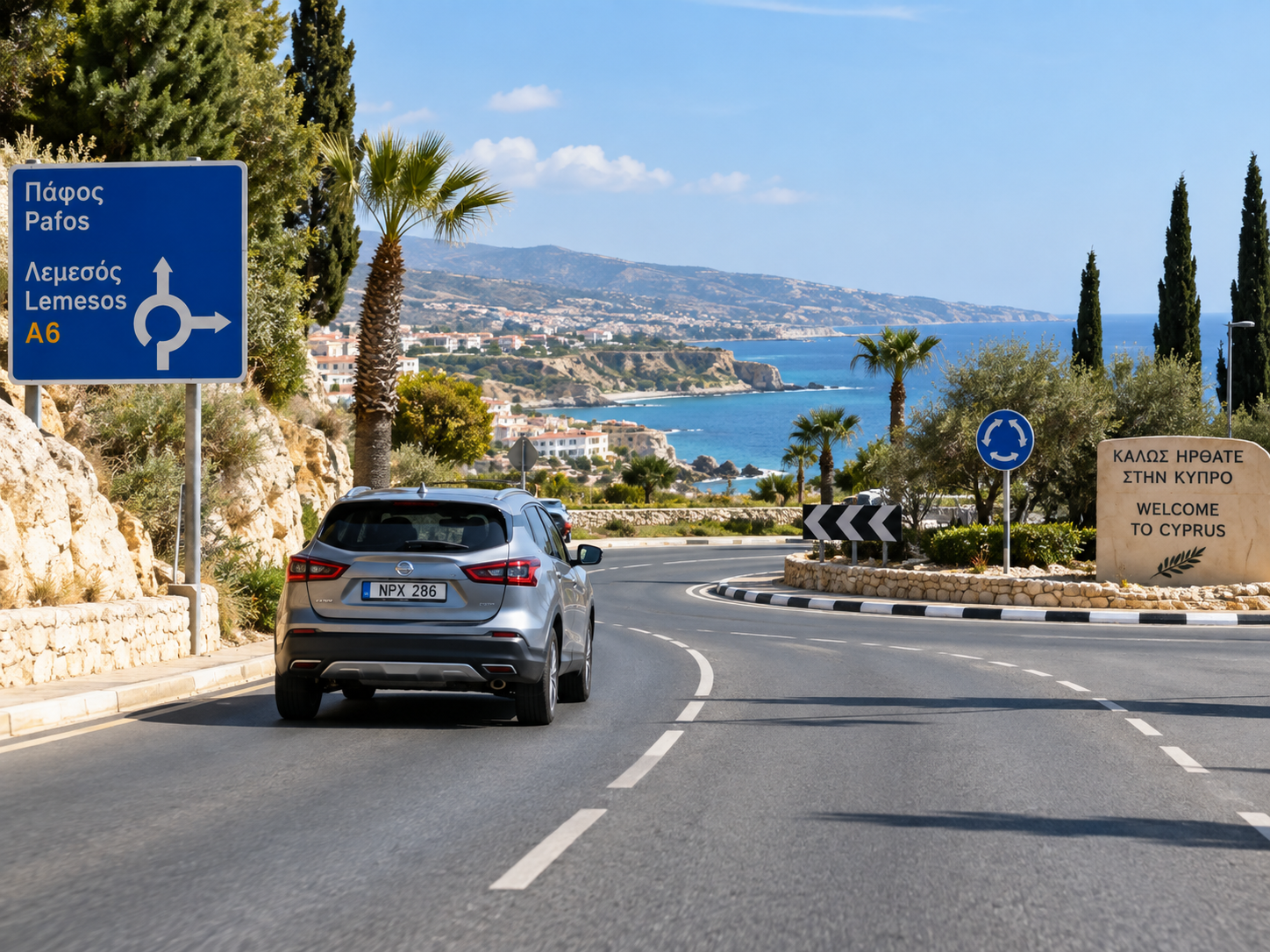
Cyprus is not a difficult country to drive in once you understand the few things that genuinely change the experience.
The first is obvious: traffic moves on the left. The second is less obvious: the roads vary enormously. A motorway between the main cities can feel uncomplicated; twenty minutes later, you may be negotiating a village street built long before anybody imagined two rental cars passing each other.
Most visitors do not need to memorize the Cyprus Highway Code before collecting a car. They do need to understand the rules that materially affect an ordinary trip, recognize when local signs override general assumptions and resist treating what they do at home as automatically correct here.
That is what this guide is for. It covers the principal driving rules and road habits relevant to visitors driving in the Republic of Cyprus. It is practical travel information, not a substitute for current legislation, official road signs or instructions from the Cyprus authorities.
Quick Answer: The Cyprus Driving Rules That Matter Most
Before driving in Cyprus, know these essentials:
- Traffic moves on the left-hand side of the road.
- Speed limits and distances are shown in kilometers and kilometers per hour.
- The general maximum motorway speed is 100 km/h, with a 65 km/h minimum, unless signs indicate otherwise.
- The general limit on many other roads is 80 km/h, unless a different limit is posted.
- In built-up areas, the general limit is 50 km/h, unless signs indicate another limit.
- Seat belts are compulsory in the front and rear.
- Children must use the appropriate restraint required by current law.
- Drivers must comply with current rules governing mobile-phone use while driving.
- Drink-driving limits apply, and different limits may apply to particular categories of driver.
- On motorways, normal driving is in the left lane; the right lane is principally used for overtaking and other permitted circumstances.
- Road signs, lane markings, temporary restrictions and police instructions take precedence over what a navigation app tells you.
If you have not yet decided whether driving makes sense for your trip, start with Driving in Cyprus. If the car itself is the question, continue instead to Renting a Car in Cyprus.
In Cyprus, You Drive On The Left
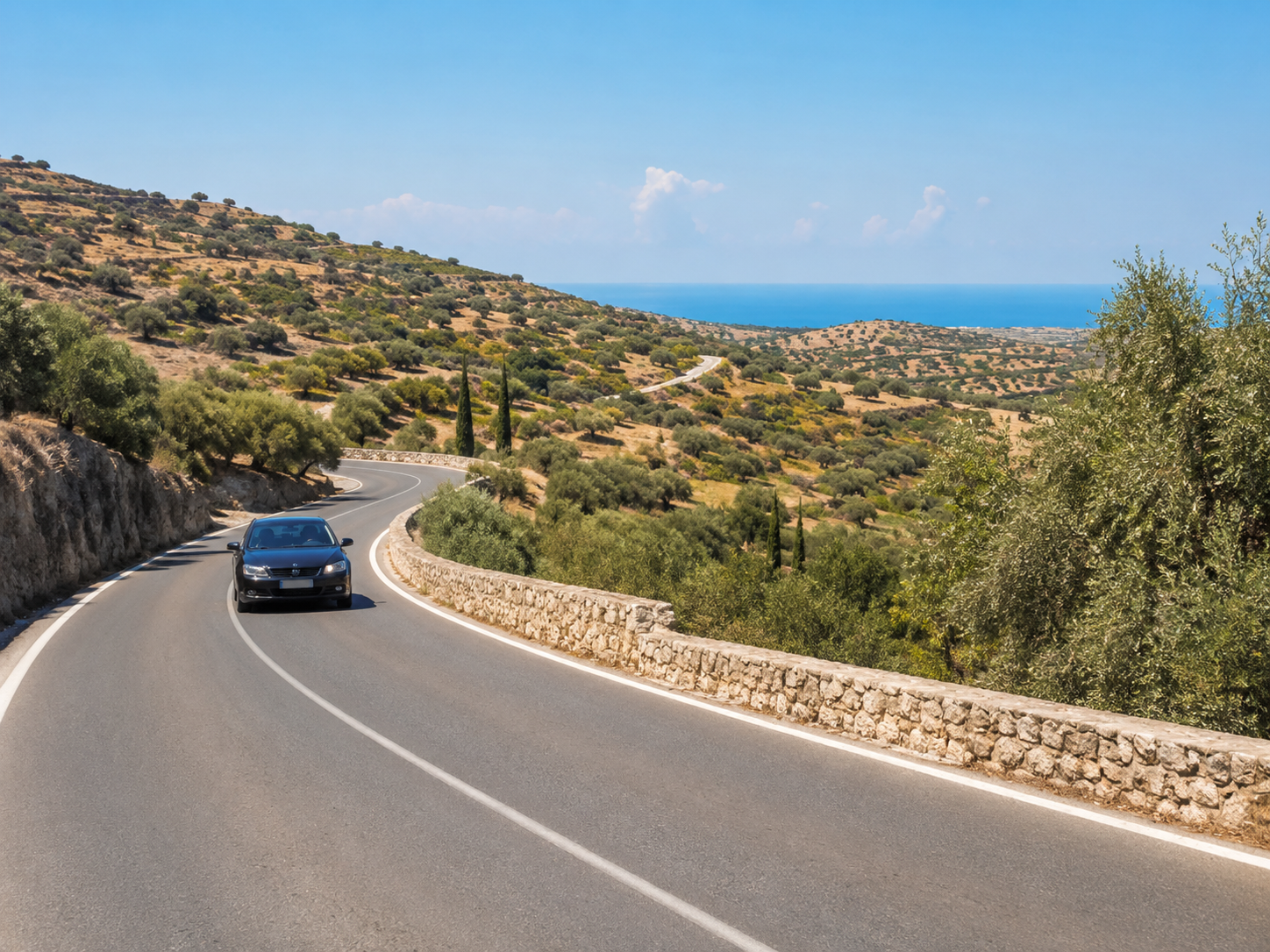
For visitors from the UK, Ireland, Malta and other left-driving countries, this part requires little adjustment. For travelers from most of continental Europe, North America and many other countries, it is the rule that shapes the first few journeys.
Traffic in Cyprus keeps to the left-hand side of the road.
The difficulty is rarely remembering that fact while cruising along a main road. The more vulnerable moments are turns, junctions, roundabouts and the moment you start driving again after stopping somewhere. You may have spent an hour perfectly comfortable on the left, stop for lunch, return to the car and momentarily fall back into the road position you have used for years at home.
That is why we would make the first day uncomplicated. Set the navigation before leaving, take a straightforward route and give yourself enough mental space to become familiar with both the car and the traffic direction.
Our specialist guide to Driving on the Left in Cyprus deals with that adjustment in detail.
Speed Limits in Cyprus

The useful starting point is simple.
The general speed framework in Cyprus is:
- Motorways: maximum 100 km/h
- Motorways: minimum 65 km/h
- Other roads: generally 80 km/h unless another limit is posted
- Built-up areas: generally 50 km/h unless signs indicate otherwise
Speed limits and distances are displayed in kilometers and kilometers per hour.
Do not treat those numbers as universal permissions. The posted limit on the road you are actually driving is the one that matters, and lower limits can apply because of the road, neighborhood, junction, construction, temporary restriction or another local condition.
A legal maximum is also not an instruction to drive at that speed regardless of circumstances. A winding mountain road, heavy rain, poor visibility or a narrow village street can require considerably less speed than the maximum otherwise permitted.
This distinction matters in Cyprus because the road environment can change quickly. A motorway may feel effortless; the road into the next village may demand an entirely different pace.
The Road Sign Wins
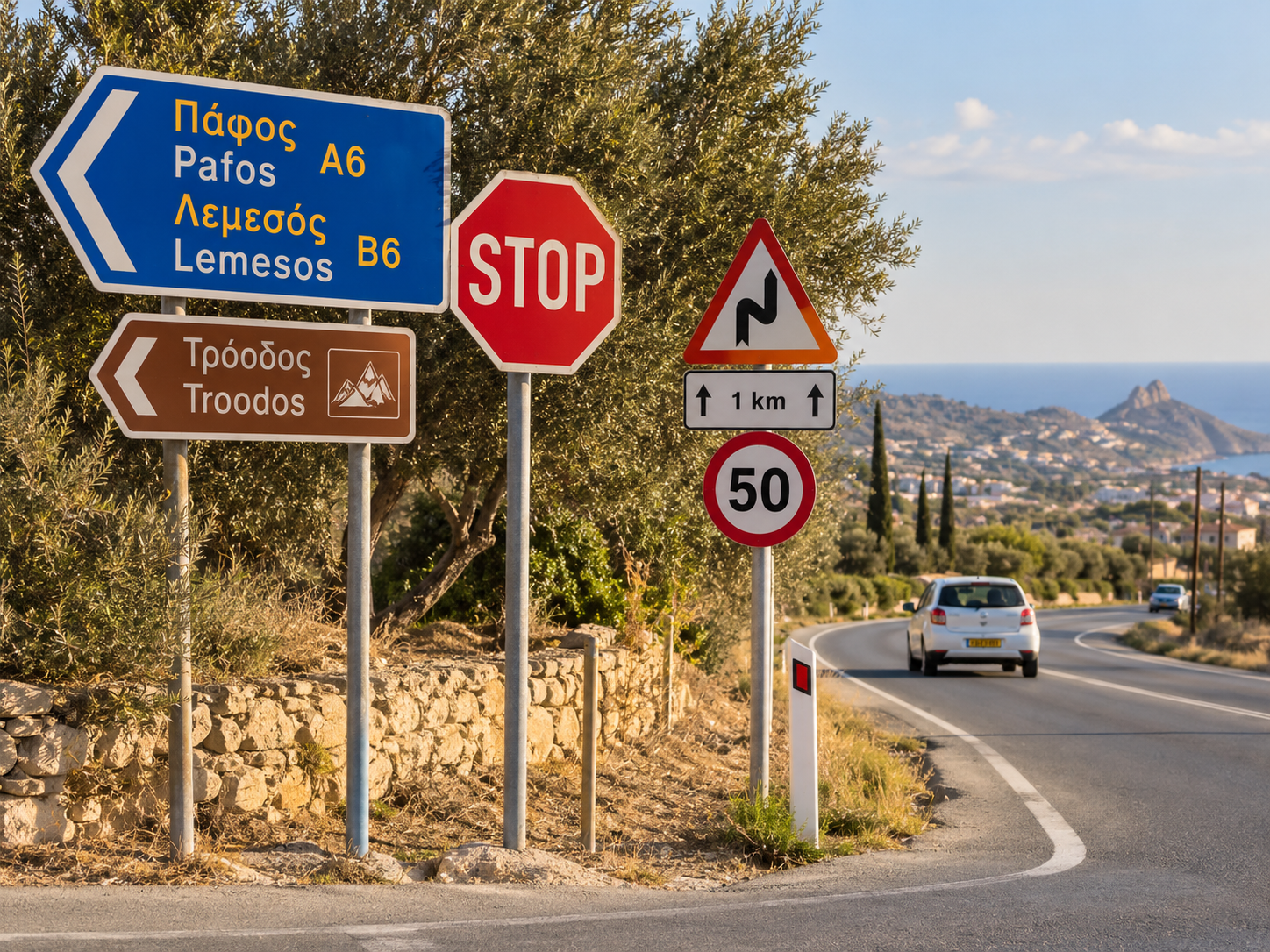
Visitors from Europe will recognize much of the visual language of Cyprus road signs, and speed and distance information uses the metric system.
The useful rule for travelers is simple: believe the road before you believe your assumptions.
If a sign imposes a different speed, restriction or direction, follow it. If temporary roadworks change the route, follow the temporary arrangement. If lane arrows tell you where a lane goes, do not continue simply because your navigation application thinks the junction works differently.
And if a police officer or another authorized person is directing traffic, follow those instructions rather than the route or signal you expected.
Navigation is excellent at telling you where you are going. It is not the authority on how you are permitted to get there.
Seat Belts Are Not Optional
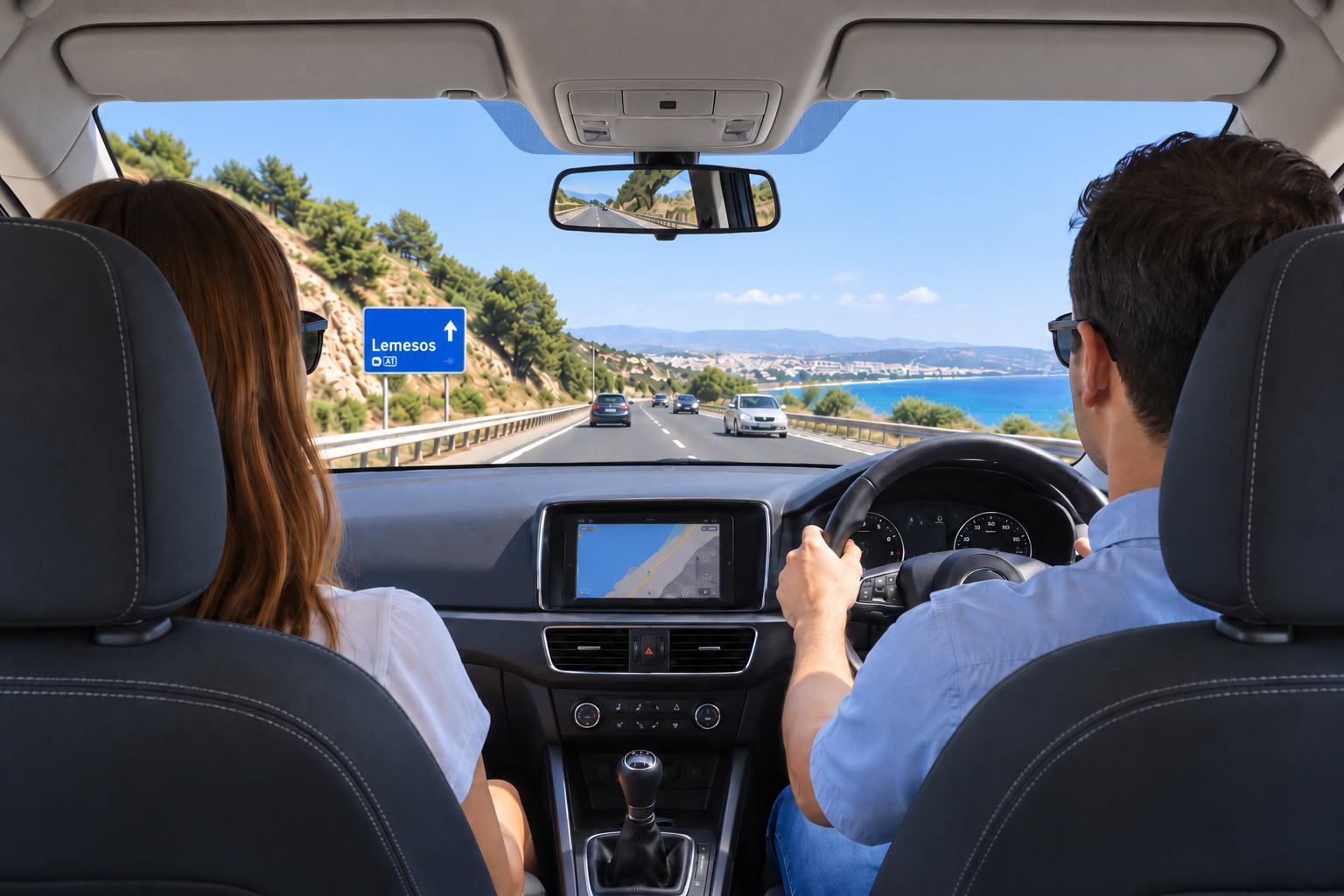
Seat belts are compulsory for the driver and passengers in both the front and rear seats.
That sounds obvious, but vacation behavior can become strangely casual. Four adults squeeze into a rental for a short restaurant journey and somebody in the rear decides the belt is unnecessary because the drive is only five minutes.
The distance does not change the requirement. If the vehicle has passengers, use the restraints required by law.
The same principle applies to apparently insignificant journeys. Moving the car only a short distance does not suspend the rules attached to driving it.
Children Need The Corrrect Restraint
Children must use an appropriate child-restraint system where required by current Cyprus law, and detailed rules can depend on factors such as the child's size, the type of restraint and where it is installed.
We would not choose a particular child seat from a travel article.
If you are renting one with the car, establish what the rental company supplies and whether it is appropriate before driving away. If you are bringing your own, check the current Cyprus requirements and make sure it can be fitted correctly to the vehicle.
This is one of those areas where “it was acceptable at home” is not enough. The relevant Cyprus rules and the correct installation matter.
Your Phone Should Not Be in Your Hand
Cyprus has rules restricting mobile-phone use while driving, and drivers should keep their attention and control on the road.
The easiest way to avoid unnecessary distraction is to deal with the phone before the car moves. Set the destination before leaving, secure the device properly if it is being used for navigation and let a passenger change the route if somebody else is in the car.
If something requires your attention and cannot be dealt with safely and lawfully while driving, stop somewhere appropriate before dealing with it.
Hands-free does not mean attention-free. A phone can still distract you even when you are not physically holding it.
Alcohol And Driving: Do Not Plan Around The Legal Limit

Drink-driving limits apply in Cyprus, and different limits may apply to particular categories of driver. Because legislation can change and individual circumstances matter, check current official requirements if the legal position is relevant to your trip.
More importantly, we would never plan a day around calculating how much somebody can drink and remain within a legal limit.
This matters particularly in Cyprus wine country. A car is one of the easiest ways to reach wineries and wine villages, but if tasting is part of the plan, decide who is driving before the first glass arrives. If everyone wants to drink, use another form of transportation.
The safest driving plan is the one that does not depend on approaching a legal threshold.
Motorways: Keep Left
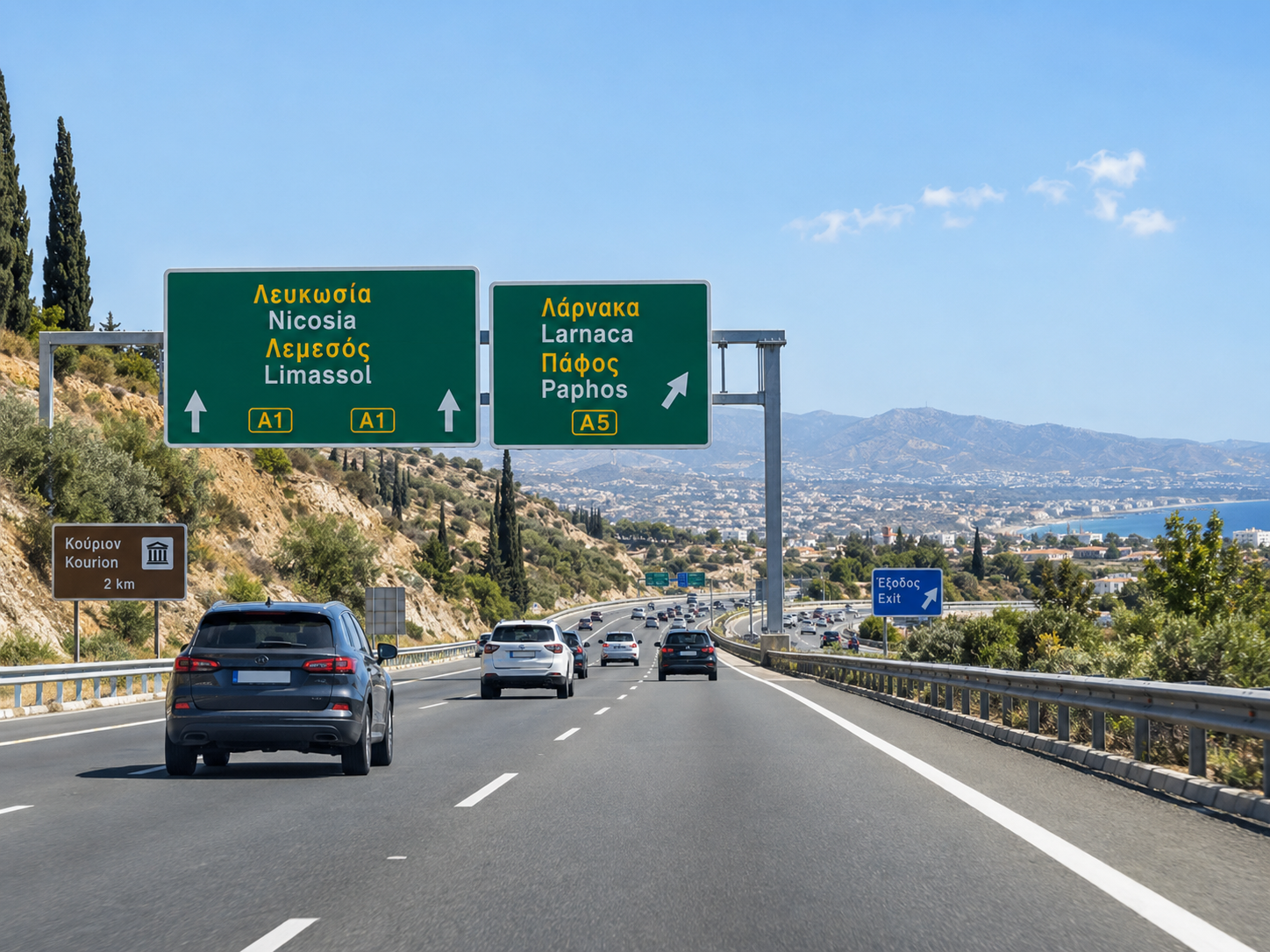
Motorway driving is usually one of the least intimidating parts of driving in Cyprus.
Vehicles normally travel in the left lane, while the right lane is used principally for overtaking and in other permitted circumstances. Drive predictably, use your mirrors and signals properly, and return to the appropriate lane when the maneuver is complete.
Do not remain indefinitely in the right lane simply because the motorway is quiet.
Ordinary stopping and parking on motorways are also prohibited. If you have a genuine emergency, however, the situation is no longer ordinary parking: deal with it safely, follow the applicable emergency procedures and obtain assistance where necessary.
Roundabouts: Slow The Process Down
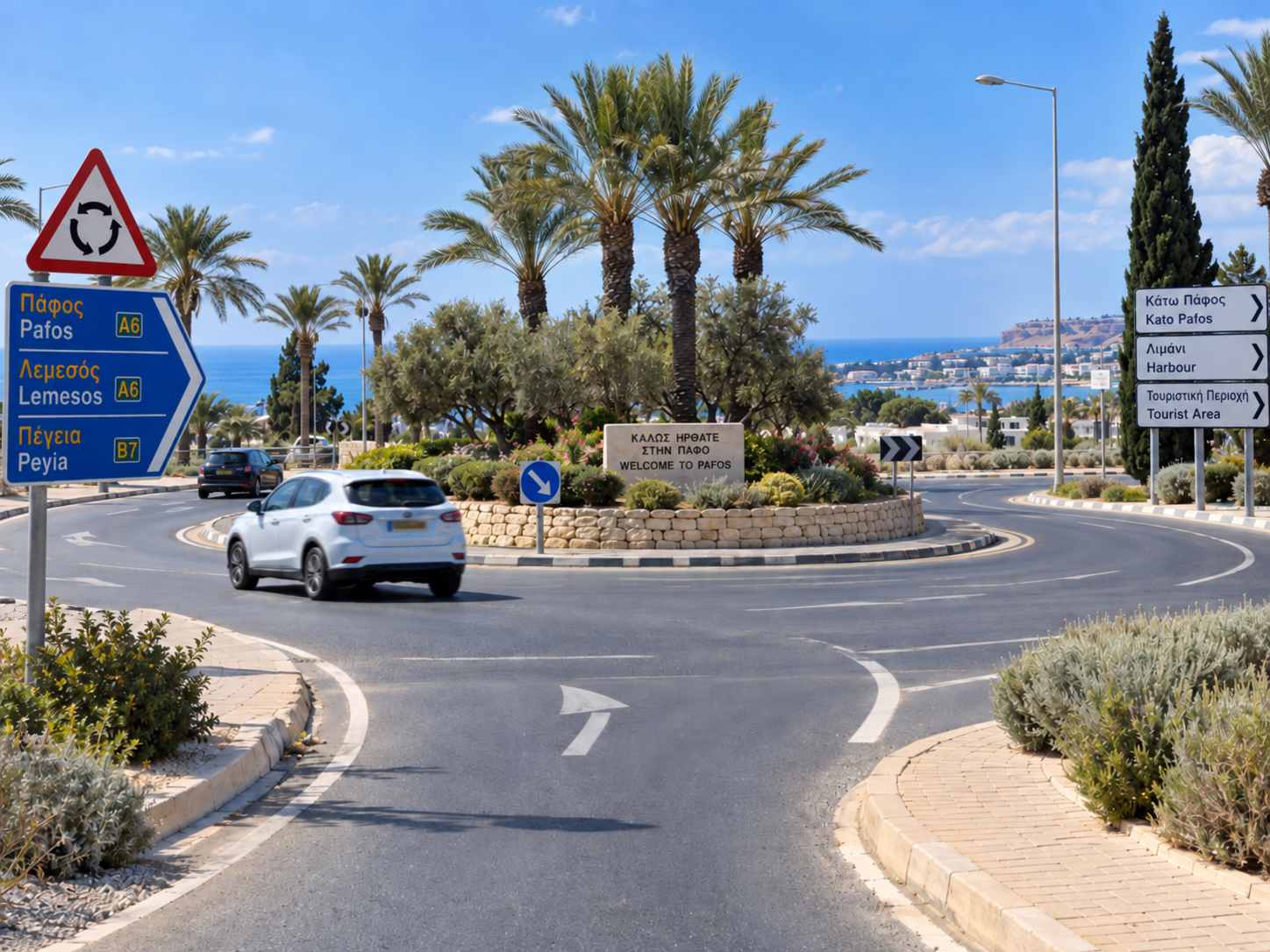
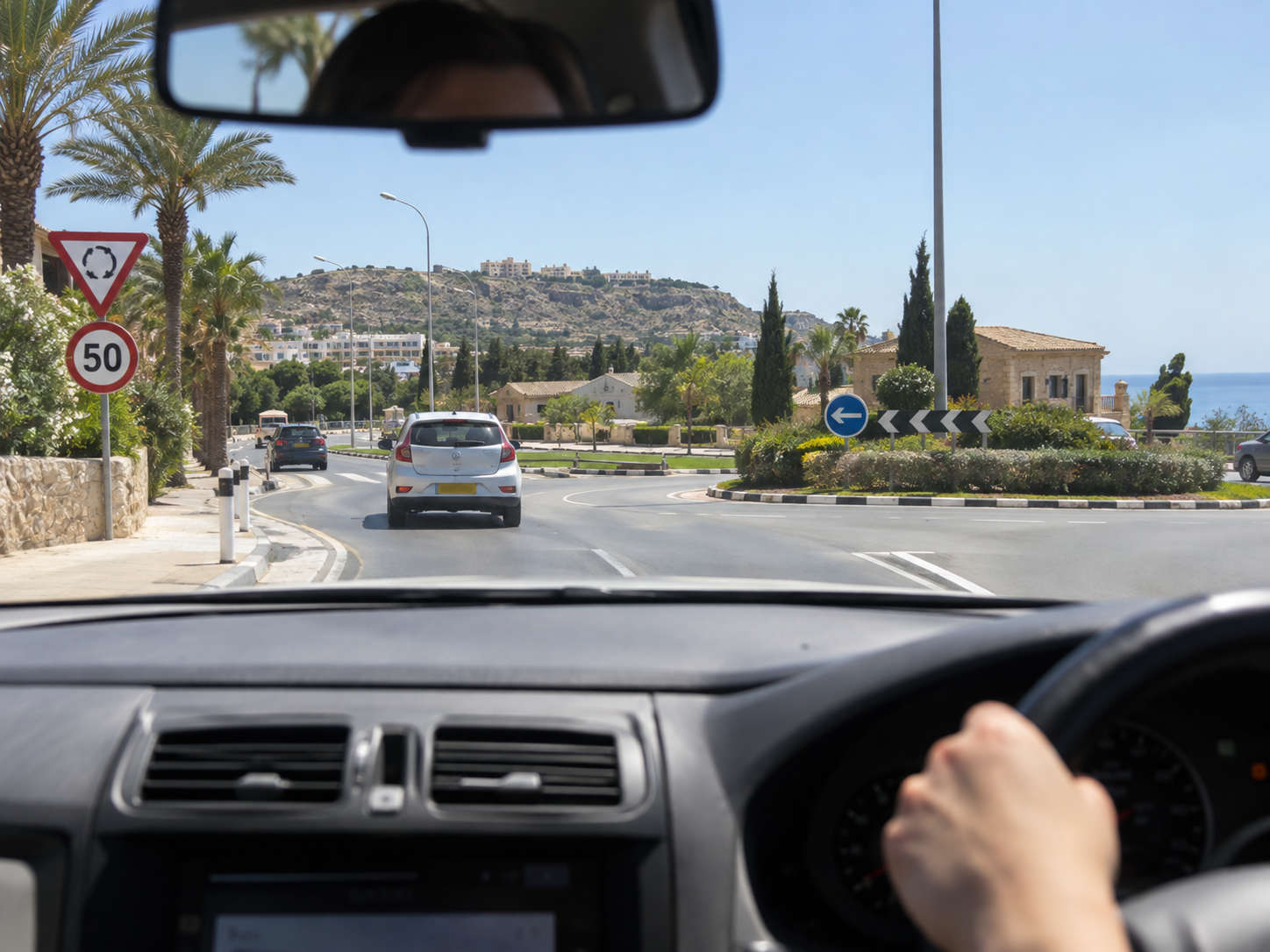
Roundabouts are one of the places where visitors adjusting to left-side driving tend to concentrate hardest, and that is sensible.
Do not approach one while simultaneously trying to reinterpret the navigation screen, decide which exit you need and remember which side of the road you are now using.
Read the signs and lane markings before entering. Choose the appropriate lane early where possible, indicate as required and remain alert to vehicles already moving through the junction.
Cyprus roundabouts operate within the island's left-side traffic system, so the movement may initially feel reversed if you normally drive on the right. The detailed mechanics belong in Driving on the Left in Cyprus rather than here.
The principle that matters most is predictability. An unfamiliar driver who approaches carefully, follows the markings and takes another circuit if necessary is considerably easier to deal with than somebody making a last-second correction because they are determined not to miss an exit.
Missing an exit is inconvenient. A rushed maneuver can be much more costly.
Do Not Import Your Home-Country Lane Habits
The fact that two countries drive on the same side of the road does not mean every junction, lane marking or local convention will feel identical.
Treat the road you are on as new information. Watch the arrows, read the signs and do not wait until the final few meters to discover that your lane continues somewhere you do not want to go.
If you make a mistake, continue safely and allow the navigation to recalculate.
There is almost always another turn. There is rarely a good reason for a desperate one.
Overtaking: Do Not Borrow Somebody Else's Confidence
You may see another driver overtake somewhere you would not.
That does not make it a recommendation.
Overtaking decisions depend on visibility, road markings, oncoming traffic, speed, road geometry and the rules applying at that location. On mountain and rural roads, the available view can disappear quickly around a bend or crest.
Follow signs and road markings and overtake only where it is permitted and clearly safe. You are not required to reproduce the pace of the vehicle behind you, either.
If another driver wants to travel faster, concentrate on driving legally and predictably rather than allowing somebody else's impatience to dictate your judgment.
Give Pedestrians, Cyclists And Motorcyclists Room
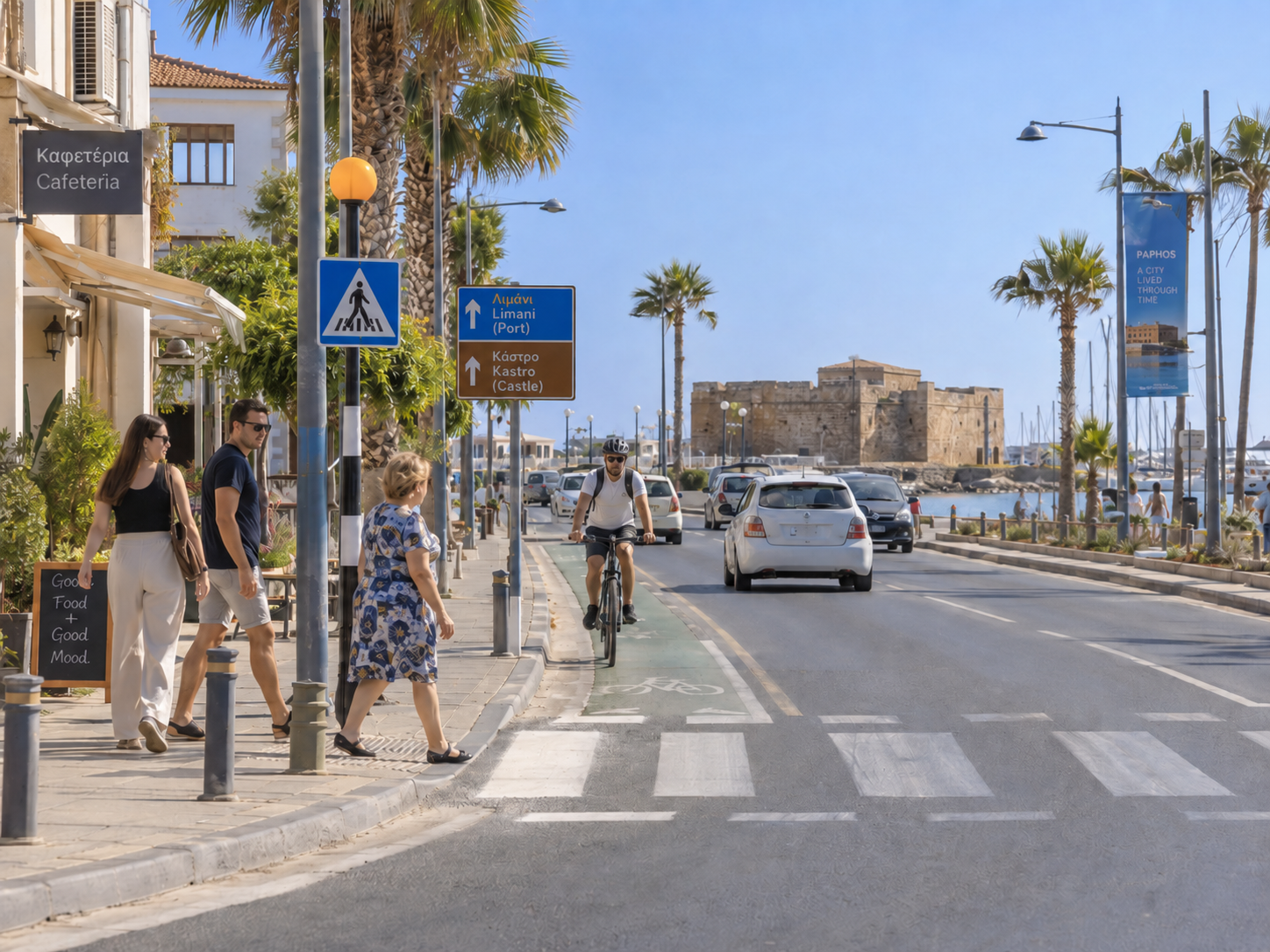
Not every Cyprus road has the pedestrian infrastructure a visitor may expect from a major northern European city.
In villages and rural areas, people may walk along roads where sidewalks are limited or absent. Cyclists and motorcyclists can also appear on roads where bends make sight lines shorter.
Reduce speed where visibility is limited, leave appropriate room and be particularly alert when entering villages, passing parked vehicles or driving through areas where pedestrians may cross between cars.
The principle is universal. The road environment may not be.
Parking Rules Are Still Driving Rules
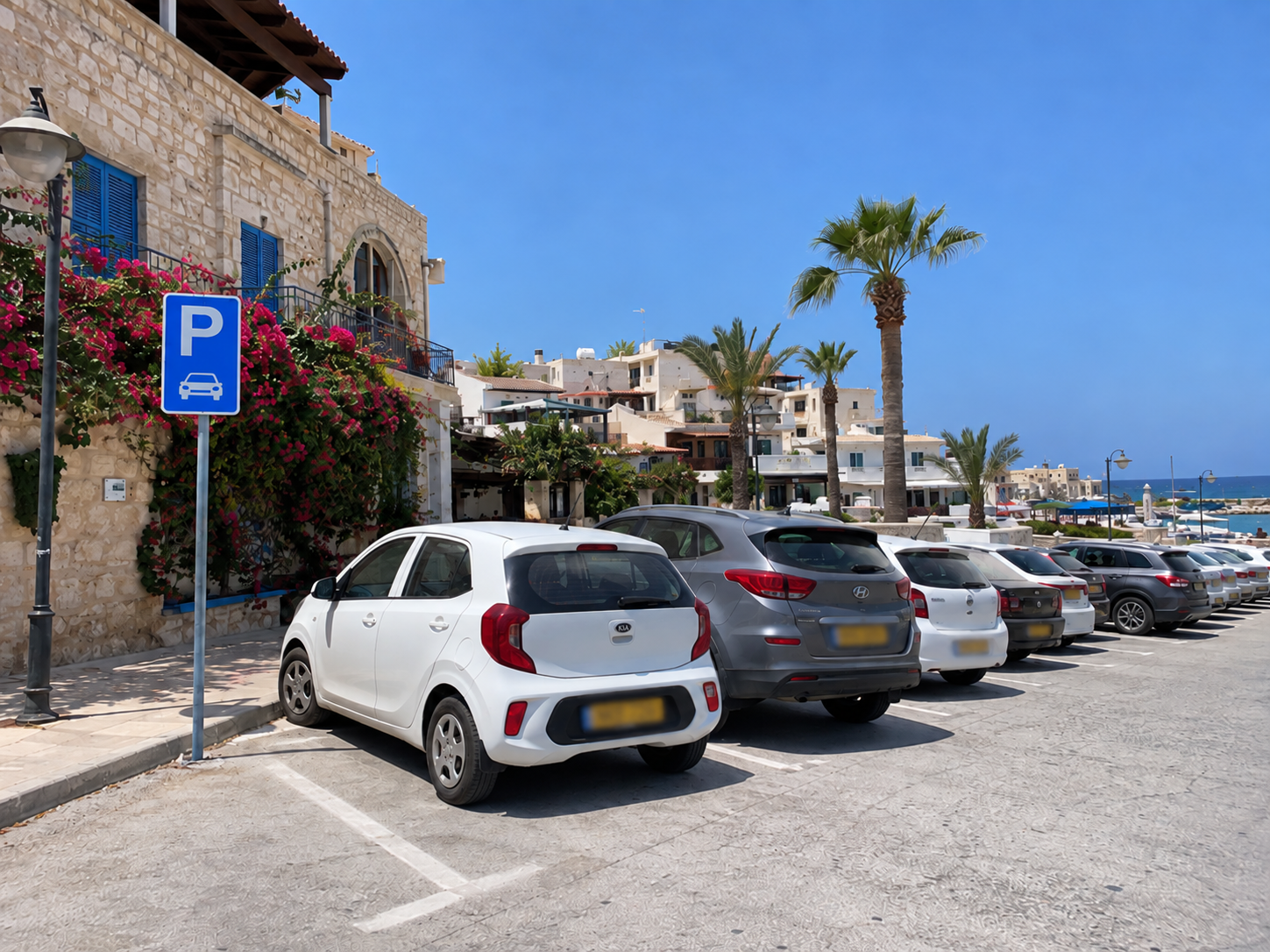
A rental car does not become exempt from traffic restrictions when the engine is switched off.
Signs, road markings, access restrictions and local parking regulations still matter. Do not treat a line of other parked cars as evidence that you are permitted to join them.
This is particularly relevant in city centers, near beaches and in old villages where limited space can encourage increasingly creative interpretations of where a car belongs.
We deal with the practical detail separately in Parking in Cyprus.
For everyday purposes, remember this: park according to the restriction, not according to what everybody else appears to be doing.
Village Roads Require Judgment, Not Bravado
 Kato Drys Village
Some of the most memorable driving in Cyprus happens away from the main roads.
It is also where common sense becomes more useful than confidence.
A road through an old village may narrow unexpectedly. Cars may be parked along one side. A navigation app may identify a lane as perfectly usable because, technically, it is.
That does not mean you have to prove the software correct.
If the street ahead looks unnecessarily tight, reconsider the route. If there is sensible legal parking on the edge of the village, walking the final section may produce a better visit anyway.
There is no achievement in squeezing a large rental car through a lane you never needed to enter.
Troodos Changes The Conditions, Not The Rules
 Cedar Valley
The legal framework does not disappear when the road climbs into the Troodos Mountains. What changes is the environment.
Bends become more frequent, gradients matter, visibility can change and weather may be very different from the coast, particularly in winter. Road conditions can change accordingly.
The correct response is not to invent a new set of mountain rules. It is to apply the existing ones with more margin.
Drive at a speed appropriate for visibility and conditions, respect road closures and temporary restrictions, and do not assume that because a route appears on a navigation app it is currently appropriate for your vehicle.
If you are planning a mountain day, read Driving in the Troodos Mountains before leaving.
Road Conditions Can Override The Itinerary
A planned route is not a commitment.
This is particularly relevant after bad weather, during roadworks or when conditions in higher areas of Cyprus change quickly. If an authority closes a road, do not treat the closure as a challenge to be navigated around using a smaller road.
Follow temporary traffic lights, diversions and police instructions. If weather makes a route uncomfortable for your experience level, turning around can be the sensible decision.
A successful road trip is not one in which every pin on the map is reached. It is one in which the route remains appropriate for the people driving it.
The Rental Agreement Can Be More Restrictive Than The Road
This catches some visitors out.
A road can be legally open and still be somewhere your rental agreement does not permit the vehicle to go. That distinction matters particularly with unsurfaced roads, certain vehicle categories and any geographical restrictions imposed by the rental company.
Traffic law tells you what is lawful on the road. The rental contract tells you what you have agreed to do with somebody else's car.
You have to satisfy both.
Before taking a rental onto a remote, unsurfaced or unusual route, check the applicable conditions rather than assuming that the vehicle's ground clearance is all the permission you need.
For the broader rental decision, see Renting a Car in Cyprus.
If There Is An Accident or Emergency
In an emergency in Cyprus, 112 can be used to reach the emergency services.
Beyond that, we would not try to prescribe one universal accident procedure in a travel article. The correct steps can depend on what has happened, whether anybody is injured, where the vehicles are, instructions from the authorities and the reporting requirements attached to a rental or insurance contract.
If you are driving a rental car, keep the rental company's emergency or assistance contact details accessible and understand its reporting process before leaving the collection point.
In an accident or breakdown, prioritize immediate safety, follow current instructions from the relevant authorities and comply with the reporting requirements applying to the vehicle. Do not make assumptions about liability or repairs simply because the situation feels awkward.
What We Would Not Memorize
We would not attempt to memorize every traffic fine, penalty point, obscure restriction or clause of Cyprus road legislation before a vacation.
That information can change, and much of it is irrelevant to an ordinary visitor who drives responsibly.
We would know the rules that govern the trip: which side of the road to use, the general speed framework, how restraints apply, how to keep the phone from becoming a distraction and why a wine-tasting day needs a transportation plan rather than an alcohol calculation.
We would understand the rental company's requirements if something went wrong. And then we would concentrate on the road.
That is considerably more useful than arriving with a mental catalog of fines.
Before You Start Driving
Before the first journey, we would check:
- that the driver is legally and contractually entitled to drive the vehicle
- that everybody is using the required restraint
- that any child restraint is appropriate and correctly installed
- that the seat and mirrors are adjusted
- that the driver knows the main controls
- that the route is set before moving
- that the phone can remain out of the driver's hands
- that anyone driving is fit to do so and has not consumed alcohol in a way that makes driving inappropriate
- that any significant mountain or rural route is open and suitable for the conditions
- that the driver understands the rental company's emergency procedure
Once you are moving, the priority becomes simpler:
Follow the signs, follow the conditions and leave yourself time to make decisions.
Check Current Rules Before Your Trip
Traffic law changes. Speed restrictions can change. Temporary road measures appear. Enforcement practices and penalties can be revised.
That is why this page deliberately does not reproduce a catalog of fines, penalties or every technical provision in Cyprus road legislation.
Before driving, check current official requirements where anything is material to your circumstances. Road signs, temporary restrictions, current legislation and instructions from the competent authorities take precedence over this or any other travel guide.
For ordinary visitors, the most useful approach is to understand the framework before the trip and then pay attention to the road in front of you.
Important: What This Guide Does And Does Not Do
This page concerns ordinary visitor driving in the Republic of Cyprus.
It provides general travel information to help travelers understand common driving rules and prepare for driving. It is not legal guidance, does not reproduce the complete Cyprus Highway Code and should not be relied upon as a definitive statement of the law applying to a particular driver, vehicle or situation.
Driving-license recognition, rental eligibility, insurance, vehicle restrictions and individual contractual conditions can depend on circumstances beyond the scope of this guide.
If a rule is material to your journey, verify the current requirement with the relevant Republic of Cyprus authority before relying on it.
The Rule That Matters After All The Other Rules
Driving in Cyprus is easiest when you stop trying to drive exactly as you would at home.
The road is giving you information all the time: the left-hand traffic tells you where to position yourself, the speed sign tells you the limit, the lane arrow tells you where you are going, and the bend tells you whether that speed still feels appropriate. A village street can tell you that continuing is not worth it; changing weather can tell you that today's mountain plan needs reconsidering.
Pay attention to all of it.
You do not need to drive like a local. You need to drive like somebody paying attention.