Newsletter "Beyond the Postcards" Subscribe
Plan Your Cyprus Trip: Hotels: Expedia, Villas & Apartments: Vrbo, Car Rentals: DiscoverCars, Tours: GetYourGuide, Airport Transfers: WelcomePickups
- Home
- Plan Your Cyprus Trip
- Airports & Arriving in Cyprus
- Larnaca Airport Transfers
Larnaca Airport Transfers: Choosing The Right Way To Your Destination
This article may contain affiliate links, meaning we earn a commission from qualifying purchases at no extra cost to you.
A transfer from Larnaca Airport looks like one of the simplest parts of a Cyprus trip. It is usually only after landing that the differences become obvious: one option takes you directly to the hotel, another leaves you at a central stop, another involves a connection, and another puts you behind the wheel of an unfamiliar car after a long flight.
The distances are rarely the difficult part. The real question is how many decisions, connections and pieces of luggage you want to manage between the Arrivals Hall and your first accommodation.
For some travelers, public transport is entirely sensible. For others, the value of a taxi or pre-booked private transfer is not simply speed but removing the final layer of travel. And if you will need a rental car throughout the trip, collecting it at the airport can make the transfer disappear altogether.
This guide is about choosing between those options. For the airport itself — arrivals, departures, car collection and what to expect inside the terminal — read Larnaca Airport Guide.
The Quick Answer
If you are staying in Larnaca, public transport can work well when your accommodation fits the route and you are traveling with manageable luggage. A taxi or private transfer is the cleaner choice when you want to go directly to the door.
For Nicosia, scheduled airport transport can be practical when the timetable and drop-off point suit you. A direct transfer becomes more attractive with several passengers, substantial luggage, a late arrival or accommodation that would require another journey after the main airport connection.
For Limassol, compare scheduled airport transport with a direct transfer rather than assuming one is automatically better. The important difference is often what happens after you reach Limassol rather than the journey from the airport itself.
For Ayia Napa and Protaras, scheduled connections can work well when arrival times and drop-off points align. Private transport becomes more useful when the flight lands late, the accommodation is away from the convenient stops or you simply want the journey to end at the hotel door.
For Troodos, the calculation changes. Mountain accommodation is less naturally suited to an airport-to-city transport system, so a rental car or prearranged direct transfer will often produce the more coherent journey.
The Transfer Decision Is Really About Friction
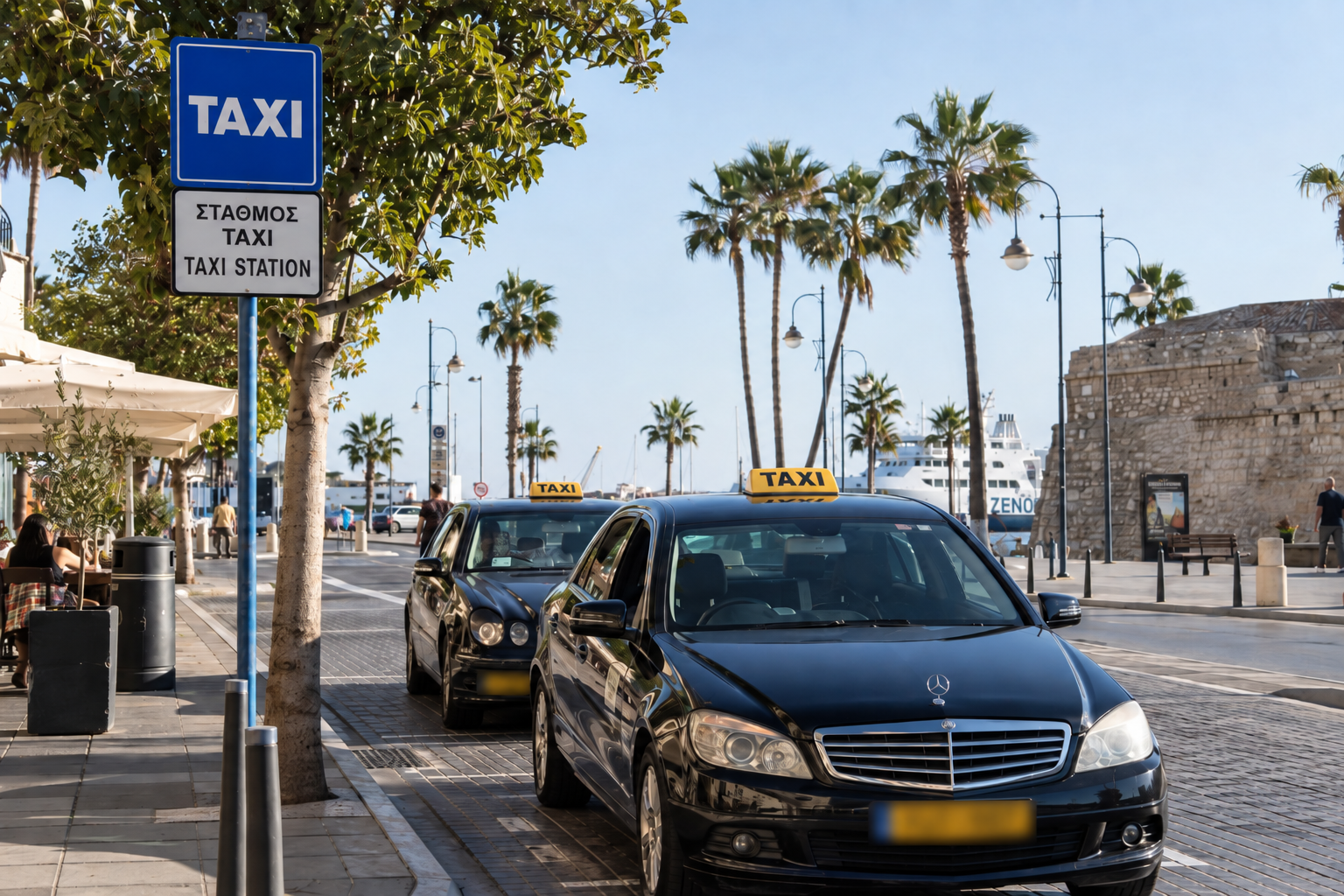
Airport transport is often compared by price and journey time. Both matter, but neither tells the whole story.
A scheduled coach may cover most of the distance efficiently but leave you needing a taxi at the other end. A public bus may be convenient for one accommodation and awkward for another. A private transfer costs more but removes waiting, connections and the need to work out the final stretch after arrival.
For a solo traveler landing during the day with one suitcase, an additional connection may be insignificant. For a family with several bags, children who have already spent hours traveling or somebody arriving late in the evening, exactly the same connection can become the part of the journey that should have been removed.
We would therefore compare the whole transfer from terminal to accommodation, not simply the longest leg. The most useful option is often the one with the right amount of friction for the traveler making the journey.
Taxi, Private Transfer or Public Transport?

A taxi or pre-booked private transfer solves the journey in the simplest possible way: one vehicle from the airport to the accommodation. That becomes particularly valuable with a late arrival, several passengers, substantial luggage or an address that is inconvenient for scheduled transport.
A taxi generally requires less advance organization. A private transfer moves more of the arrangement to before the flight, which can be useful when you want the vehicle booked, the destination confirmed and the arrival process settled in advance.
Public transport can make more sense when you are traveling light, arriving at a convenient time and staying somewhere that works naturally with the route. The mistake is treating the existence of a service as proof that it is convenient for your particular trip.
The useful distinction is between available and useful. A transport option can exist without being the right one for your arrival.
Welcome Pickups: A Pre-Booked Private Transfer

For travelers who prefer to arrange door-to-door transport before flying, WelcomePickups is one private-transfer option from Larnaca Airport.
Welcome Pickups currently allows travelers to arrange and prepay airport transfers online, with the company providing booking information and driver details before the journey. Its Larnaca service is designed around pre-booked, door-to-door airport transfers rather than turning up and finding transport after landing. Services, vehicle availability, prices and booking conditions can change, so check the current details for your journey before paying.
We would not book a private transfer merely because it is the more expensive option. Its value is specific: it can remove waiting, connections and arrival-day decision-making when those things matter to you.
Larnaca Airport To Larnaca
 Saint Lazarus Church, Larnaca
This is usually the simplest transfer on the page. If you are staying in Larnaca itself, you are already close to your first destination, so the main question is whether public transport fits the location of the accommodation.
For travelers arriving at a convenient time with light luggage, the bus can be perfectly reasonable. Check where it actually leaves you, however. A journey that looks easy on a route map may become less attractive if the final stop is followed by a long walk or another vehicle.
A taxi or private transfer removes that final calculation and is particularly attractive after a late flight or when you simply want the travel day to end. Renting a car purely to solve the airport-to-Larnaca journey rarely makes sense unless you also want the car for the wider trip.
Larnaca Airport To Nicosia
 Ledra Street, Nicosia
Nicosia is where the difference between an airport connection and a door-to-door transfer becomes important.
Scheduled airport transport can make the main journey relatively straightforward, but it will not necessarily leave you at your hotel, apartment or final address. Before choosing it, look at the complete journey from the Nicosia drop-off point rather than treating arrival in the city as the end of the transfer.
For one or two travelers arriving at a convenient time and staying somewhere easily reached afterward, that can be a sensible compromise. For families, groups, late arrivals or accommodation requiring another taxi anyway, direct transport becomes easier to justify because it removes an extra stage rather than merely replacing the highway journey.
A rental car can also work well when Nicosia is the beginning of a wider Cyprus itinerary. If most of the stay will be in central Nicosia, however, do not let one airport journey determine whether you rent a vehicle for the whole trip.
Larnaca Airport To Limassol
 Limassol Molos
Limassol is the route where we would compare rather than default.
Scheduled airport transport can cover the main distance efficiently, particularly when your flight arrives at a convenient time. The question is what happens after you reach Limassol. If the accommodation requires another taxi or an awkward final connection, include that in both the cost and the effort of the journey.
For a solo traveler or couple traveling light, that extra stage may be insignificant. With several passengers, considerable luggage or a late arrival, one direct vehicle can become much more attractive because the difference is no longer simply price; it is whether the transfer ends at a city stop or at your accommodation.
Limassol is also the destination where the original airport choice deserves particular attention. If you have not yet booked the flight, read Larnaca Airport vs Paphos Airport before assuming Larnaca should be your arrival point.
Larnaca Airport To Ayia Napa
 Nissi Beach, Ayia Napa
For Ayia Napa, Larnaca Airport is generally the natural arrival point. Scheduled transport can work well when the service fits your flight and the drop-off point is convenient for the accommodation.
That final detail matters. Ayia Napa is not one hotel location, and a transport option that reaches the resort does not necessarily deliver you close enough to where you are actually staying.
A taxi or private transfer becomes more persuasive after a late arrival, with a family or substantial luggage, or when another connection would otherwise be necessary. If you plan to explore beyond Ayia Napa throughout the trip, collecting a rental car may solve both the airport transfer and the wider mobility question, but choose the car for the holiday as a whole rather than for one journey from the terminal.
Larnaca Airport To Protaras
 Protaras Coastal Path
Protaras follows much of the same logic as Ayia Napa, but accommodation location matters even more because the wider resort area stretches beyond one compact center.
Scheduled airport transport can be a good fit when its timetable and drop-off point work naturally with your accommodation. Before booking around it, check the final segment carefully.
For families arriving with several cases, travelers staying away from the convenient stops or anyone who wants the arrival to end at the accommodation rather than at another transport point, direct transport can remove enough inconvenience to justify the additional cost.
The useful question is not simply whether public transport reaches Protaras. It is whether it reaches your version of Protaras easily enough.
Larnaca Airport To Troodos
 Platres Village
Troodos is different because there is no single “Troodos transfer.”
A hotel in Platres, a stay in Kakopetria and a village house elsewhere in the mountains create different journeys. The final mountain section matters more than the first stretch away from the airport, which makes generic airport-to-city thinking less useful here.
If you will use a car throughout the mountain stay, collecting one at Larnaca Airport can be the cleanest solution. It avoids arranging another vehicle later and provides the independence that many Troodos itineraries benefit from.
The trade-off is the first drive. Travelers unfamiliar with driving on the left should consider arrival time, fatigue, weather and their own comfort before deciding to begin a mountain journey immediately after flying.
A pre-booked private transfer can be a better fit when you do not want to drive on arrival or when the stay does not otherwise justify renting a car. Give the provider the exact accommodation rather than simply saying “Troodos,” because mountain locations should not be treated as interchangeable.
For the driving side of the decision, read Driving in The Troodos Mountains.
Late Arrivals Change The Calculation
A connection you would happily make in the middle of the day can feel quite different late at night. That does not automatically make a private transfer necessary, but it increases the value of certainty.
Check whether the transport you intend to use still works for the flight you have actually booked, not simply whether the route operates in general. If you pre-book a transfer, provide the correct flight information and understand the provider's procedure if the aircraft is delayed. Accommodation access is a separate issue, so confirm late check-in directly with the property as well.
The objective is not to eliminate every possible disruption. It is to avoid building an arrival where one delay creates several new problems.
Families, Groups And Luggage

For several passengers traveling together, compare the total journey rather than multiplying the cheapest individual fare and stopping there.
Add any final taxi or connection that will still be required. Then consider how many times the luggage has to be moved, whether everybody travels together and whether children or older family members will be asked to negotiate another stage after the flight.
If you need child seats, mobility assistance, additional luggage capacity or space for specialist equipment, provide those requirements when arranging transport and obtain confirmation from the provider. Do not assume that a standard vehicle will meet a non-standard requirement.
Vehicle capacity matters as much as passenger capacity. A group and its luggage have to fit together.
Should You Rent A Car Instead?

If you will genuinely need a rental car from the first day onward, the most efficient airport transfer may be no transfer at all.
Collecting a car at Larnaca Airport can work particularly well for villa stays, multi-base itineraries, Troodos trips and travelers planning substantial exploration. The same vehicle handles the first journey, the trip itself and the return to the airport.
It makes less sense when the car will spend most of the holiday parked. A stay in a well-positioned Larnaca hotel or a trip centered largely on one resort does not necessarily justify renting a vehicle simply because airport collection is convenient.
For the full decision, read Renting A Car in Cyprus rather than allowing one airport journey to determine transport for the entire stay.
What To Check Before Booking
Before paying for any private transfer, confirm the pickup arrangement, exact destination, quoted price, luggage allowance and vehicle capacity. If you need a child seat, accessible vehicle or space for unusual luggage, confirm it specifically.
For buses, coaches and other scheduled services, check the route, timetable, final stop and any connection for the actual date of travel. Services, fares, stops and operating times can change, so this guide deliberately concentrates on the decision rather than reproducing timetables that may date quickly.
Use the article to decide which type of transfer fits the trip, then use the relevant provider to confirm what is operating when you travel.
Continue Planning
For the airport itself, read Larnaca Airport Guide. If you have not yet decided whether Larnaca or Paphos makes more sense for your itinerary, continue to Larnaca Airport vs Paphos Airport.
For broader transport choices around the island, read Getting Around Cyprus. If you are considering driving, continue to Renting A Car in Cyprus, Driving in Cyprus and Driving On The Left in Cyprus.
The Best Transfer Is The One That Ends The Journey
It is easy to optimize airport transport as though the cheapest fare or shortest scheduled journey must be the answer. That misses what the transfer is there to do.
You have already traveled to Cyprus. The next vehicle is simply the bridge between the flight and the place you chose to stay. For some travelers, public transport crosses that bridge perfectly well. For others, one direct vehicle is worth paying more for because the luggage goes down once and the travel day ends at the accommodation door.
Choose the option that fits the arrival you will actually have, not the one that looks neatest on a spreadsheet.